Citrus Springs & Citrus County
Restoration that starts with an honest scope.
iFIXED repairs and rebuilds Citrus County homes and businesses after water, fire, smoke, and storm damage. We document what the damage actually reached, then put the building back together in the right order.
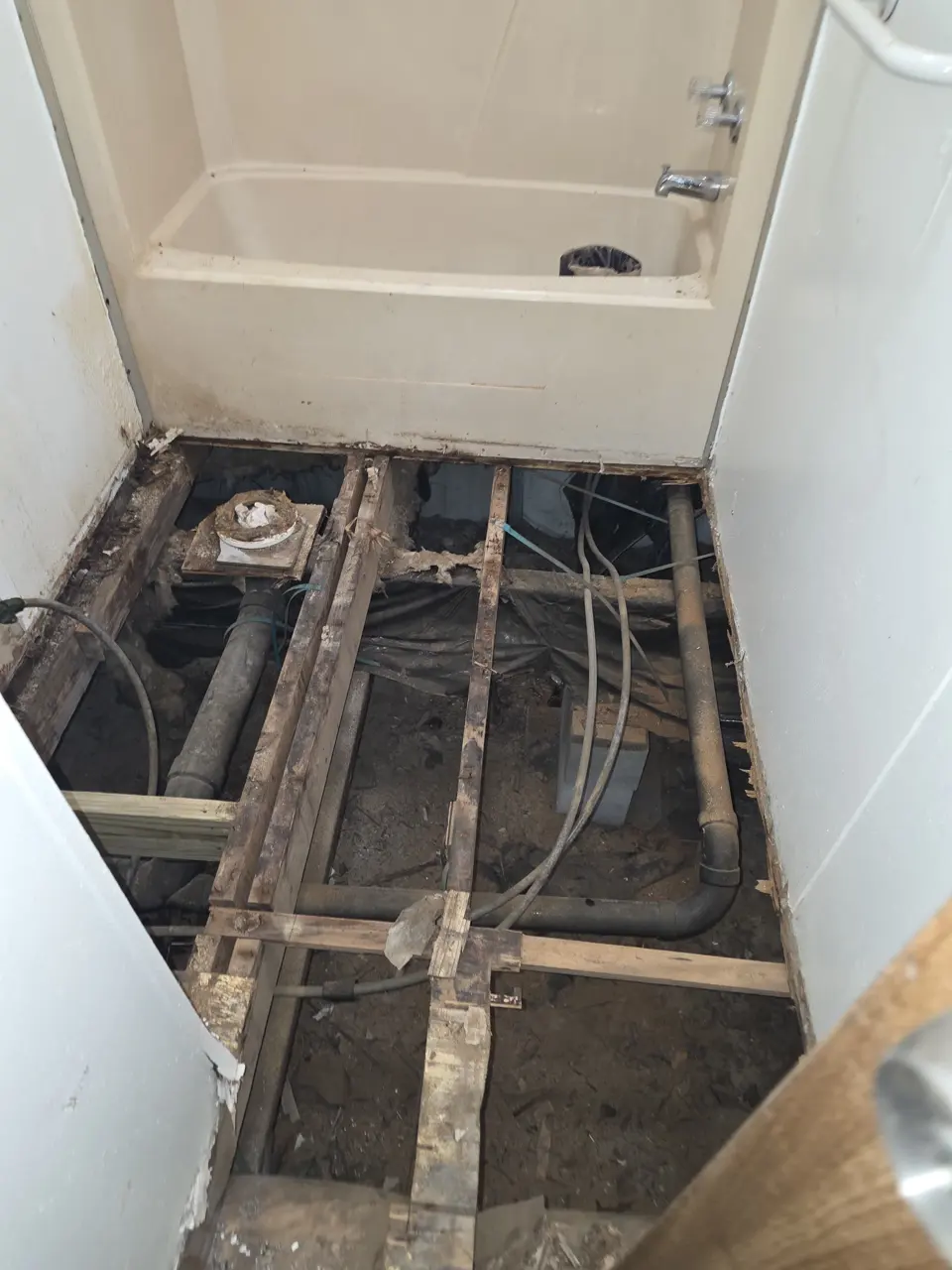
Damage travels further than the stain.
The visible mark is where the loss shows, not where it stops. Water follows framing and gravity. Smoke follows air. Wind finds the opening you cannot see from the ground. A restoration scope that only covers the obvious room is the reason so many repairs get reopened as a supplement later.
Where restoration repair starts, and what comes first.
If water is still active, or the structure has not been dried and cleared, that emergency mitigation step comes first and is usually handled by a mitigation company with drying equipment and moisture logging. Tell us where the property currently stands. We plan the repair scope around what has already been done, and we will ask for the mitigation company's moisture readings and drying logs so the rebuild does not start over damp material.
From there the work is ordinary construction done in a disciplined order: confirm the demolition line, correct any framing or subfloor damage, close the assembly, then run the finish trades. Much of it is the same work covered under flooring installation and repair, doors and trim, interior and exterior painting, and renovations — the difference is that a restoration scope has to prove what was damaged, not just describe what will be installed.
Documentation that survives an adjuster's review.
The single most common reason a restoration claim stalls is a scope that cannot be tied back to evidence. Before demolition covers anything up, we record it.
- Dated wide photos of every affected room plus close-ups of the damage boundary, from before demolition begins.
- Measured room dimensions, ceiling heights, and affected square footage, recorded per room rather than as a single total.
- Moisture readings and drying logs from the mitigation company, when that work was already performed.
- An itemized scope broken out by room and trade, so line items can be matched against the adjuster's estimate instead of argued in the aggregate.
- Hidden damage found after demolition photographed and documented as a supplement, with the reason it could not have been seen at first inspection.
What to send for an estimate
- What happened and roughly when, plus whether the source has been stopped and whether anyone has already dried the space.
- Wide photos of each affected room and close-ups of ceilings, walls at floor level, and any staining, soot, or buckling.
- Whether an insurance claim has been filed, and the adjuster's estimate or scope if you already have one.
- Which rooms must stay usable, and whether anyone is living in or operating out of the property during the work.
Restoration in Citrus County: common questions
Do you handle the emergency water extraction and drying?
Tell us the current condition of the property when you write. Emergency extraction, structural drying, and clearance are a separate first stage with their own equipment and moisture logging, and on many losses a mitigation company has already been out before we are called. iFIXED is scoped around the repair and rebuild that follows. If nothing has been done yet, say so in your first message so we can tell you what has to happen before repair work can be scheduled.
Will you work with my insurance adjuster?
We write an itemized scope by room and trade, with dated photos and measurements, in a form your adjuster can compare line by line against their own estimate. We are not a public adjuster and we do not negotiate your claim for you, but a documented scope is usually what the disagreement turns on, so we put the effort there.
What happens when the damage is worse than it looked?
It frequently is, because the assessment happens before demolition. When opening a wall or pulling flooring reveals damage nobody could have seen at first inspection, we stop, photograph it in place, and document it as a supplement with the reason it was not visible earlier. That is a normal part of a restoration claim, not a surprise charge.
How long does a restoration rebuild take?
It depends on how much has to be opened up, whether framing or subfloor is involved, whether a permit and inspection are required, and how quickly the claim scope is agreed. The honest answer is that the approval timeline is often longer than the construction timeline. We would rather give you a real sequence after seeing the property than a number that ignores the parts outside our control.
Do you cover fire restoration outside Citrus County?
Yes. We are based in Citrus Springs and work throughout Citrus, Marion, Sumter, Hernando, and Levy counties, with a staffed team in Tampa. Include the property address in your request so we can confirm scheduling for your location.